What is an AC Portable EV Charger and How Does It Work?
The demand for electric vehicles (EVs) has surged dramatically in recent years. A significant report from the International Energy Agency (IEA) reveals that global EV sales surpassed 6.6 million in 2021, marking a 108% increase from the previous year. This growth highlights the need for accessible charging solutions. An AC Portable EV Charger addresses this necessity effectively.
AC Portable EV Chargers provide flexibility for users. They empower EV owners to charge their vehicles in various locations. This convenience is crucial as public charging infrastructure is still developing. According to a report by BloombergNEF, around 1.3 million charging points will be needed worldwide by 2025 to meet demand. However, this is a challenge in many regions.
While AC Portable EV Chargers offer many benefits, they are not without issues. Charging speeds can vary, and users may experience compatibility concerns with different EV models. These factors require careful consideration when choosing a charger. Therefore, while AC Portable EV Chargers appear as a practical solution, it is vital to remain critical of their limitations as the industry continues to evolve.
What is an AC Portable EV Charger?
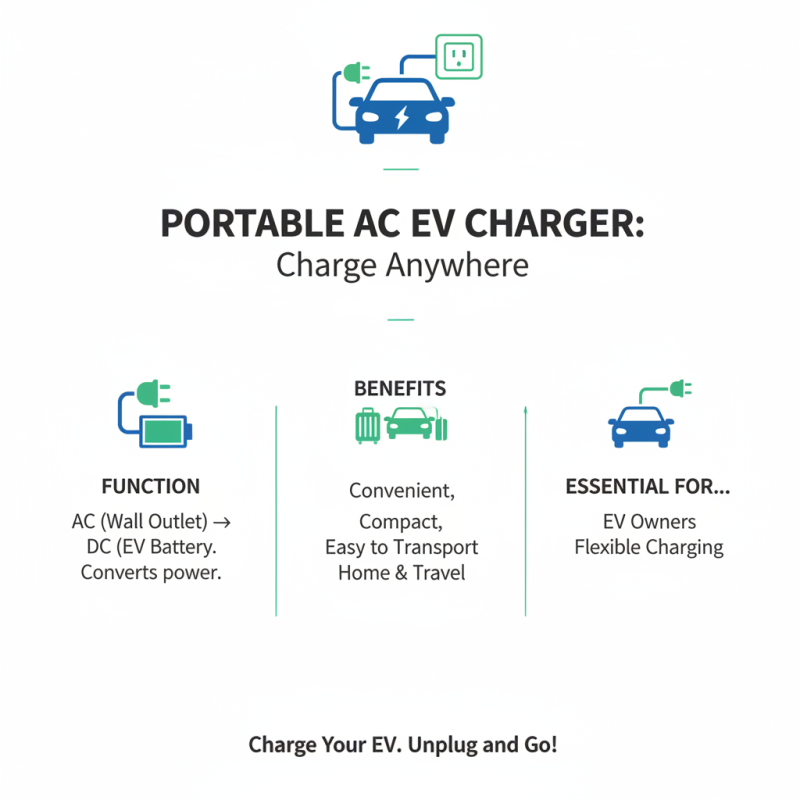
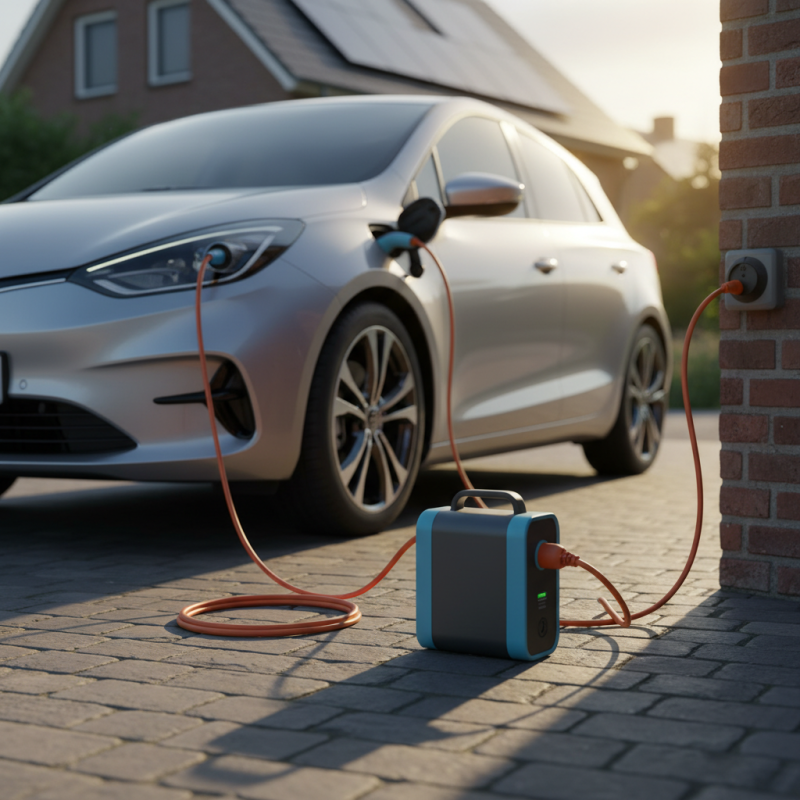
An AC portable EV charger is a versatile tool for electric vehicle owners. It allows users to charge their vehicles anywhere there’s a standard electrical outlet. This means you can plug it into your home’s garage, a parking lot, or even a friend’s house. Its compact design makes it easy to carry and store.
These chargers work by converting alternating current from the outlet into a usable form for the electric vehicle’s battery. They typically come with various connectors to fit different vehicle models. However, charging speed can vary. A standard outlet might take longer to charge than a dedicated charger. Users often find they need to wait for several hours for a full charge, which can test patience.
While AC portable EV chargers are convenient, they do have limitations. Many people underestimate the charging time. It’s important to plan trips accordingly. Sometimes, users may find they’ve run low on battery without a nearby charging point. This could lead to unexpected detours or delays. The reliability of the charger is also crucial. Quality can vary widely among different options in the market. Some chargers might not perform as expected, leading to frustration.
Charging Speed Comparison of AC Portable EV Chargers
This chart illustrates the charging speed of different levels of AC portable EV chargers. As shown, Level 1 chargers provide a slower charging speed compared to Level 2 and Level 3 chargers, making them suitable for overnight charging, while Level 3 chargers offer the fastest charging capabilities for quick top-ups.
Key Features of AC Portable EV Chargers
AC portable EV chargers are essential for electric vehicle owners. They are designed for convenience and flexibility. These chargers typically plug into standard electrical outlets, allowing users to charge their vehicles at home or on the go. They are lightweight and easy to transport. However, not all chargers are created equal.
Key features of AC portable EV chargers include adjustable power settings. This allows charging at various speeds, depending on the power source available. Many chargers also include safety features, such as overcurrent protection and temperature control. The length of the charging cable matters. A longer cable offers more flexibility in parking. Some models have smart features, enabling users to monitor charging progress through mobile apps. Yet, battery health can be a concern. Users must be aware of not letting their battery drop too low.
While AC portable EV chargers provide convenience, they may not be as fast as DC fast chargers. Charging speed can vary based on the power supply. Users need to plan accordingly, especially for long trips. Sometimes, users may experience compatibility issues with certain vehicle models. It's crucial to check specifications before purchasing a charger. Balancing convenience with performance often requires careful consideration.
How AC Portable EV Chargers Function and Charge Electric Vehicles
AC portable EV chargers are essential for charging electric vehicles conveniently. They convert alternating current (AC) from a standard power outlet into direct current (DC) for the vehicle's battery. These chargers are compact and easily transportable, making them ideal for home use or travel.
According to a recent industry report, the market for portable EV chargers is expected to grow rapidly. The demand is driven by increasing EV sales. In 2022, approximately 6 million electric vehicles were sold globally, highlighting the need for accessible charging solutions. These chargers can typically deliver 3.7 kW to 22 kW of power, allowing an EV to charge overnight. Despite this, many users may face issues with charging time or compatibility.
The charging process involves a few simple steps. Users connect the charger to a standard outlet and plug the other end into their vehicle. The duration depends on the vehicle and charger capacity. On average, it takes 4 to 8 hours for a full charge using a portable AC charger. However, some users may find that their vehicles have varying charging capabilities. This can lead to frustration. Understanding vehicle specifications can minimize these challenges. As the market evolves, so should user education and technology development.
Industry Standards and Compatibility for AC Portable EV Chargers
When considering an AC portable EV charger, compatibility and industry standards are crucial factors. These chargers must meet specific safety and performance guidelines to ensure they work effectively with various electric vehicle models. The Society of Automotive Engineers (SAE) and the International Electrotechnical Commission (IEC) set standards that govern the design and functionality of these chargers. Adhering to these standards ensures reliable charging and minimizes risks.
The ability to connect with multiple EV brands hinges on the charger’s design. Not all chargers are created equal. Some may only work with specific models or brands, leading to frustration for users. This variability can be confusing. Moreover, users must consider the voltage and amperage specifications of their vehicle. A mismatch can delay charging. It’s essential to carefully check compatibility before making a purchase to avoid complications later.
In the world of portable EV chargers, the user experience can vary. Some chargers are lightweight and easy to carry, while others are bulky. This inconsistency can affect portability and convenience. Users should weigh their options and consider practicality. Think about how often you travel. Portable chargers should ideally fit your lifestyle. The right choice can enhance your EV experience.
What is an AC Portable EV Charger and How Does It Work? - Industry Standards and Compatibility for AC Portable EV Chargers
| Feature |
Description |
Compatibility |
Charging Speed |
Standards |
| Power Output |
Typically ranges from 3.7 kW to 22 kW |
Compatible with most EV models |
Up to 25 miles of range per hour of charge |
IEC 62196, SAE J1772 |
| Portability |
Lightweight and easy to transport |
Works with various EV models |
Depends on power source |
UL Certification |
| Charging Cable |
Flexible cables, often 16-25 feet long |
Standard for most public and home chargers |
Varies with EV type |
EV-specific norms |
| User Interface |
LED indicators to show charging status |
User-friendly across all models |
Instant feedback during charging |
Meets ergonomic guidelines |
| Safety Features |
Overcurrent, overvoltage, and thermal protection |
Applicable for all EVs |
Enhances user safety |
Complies with CE, FCC regulations |
Benefits of Using an AC Portable EV Charger for Electric Vehicle Owners
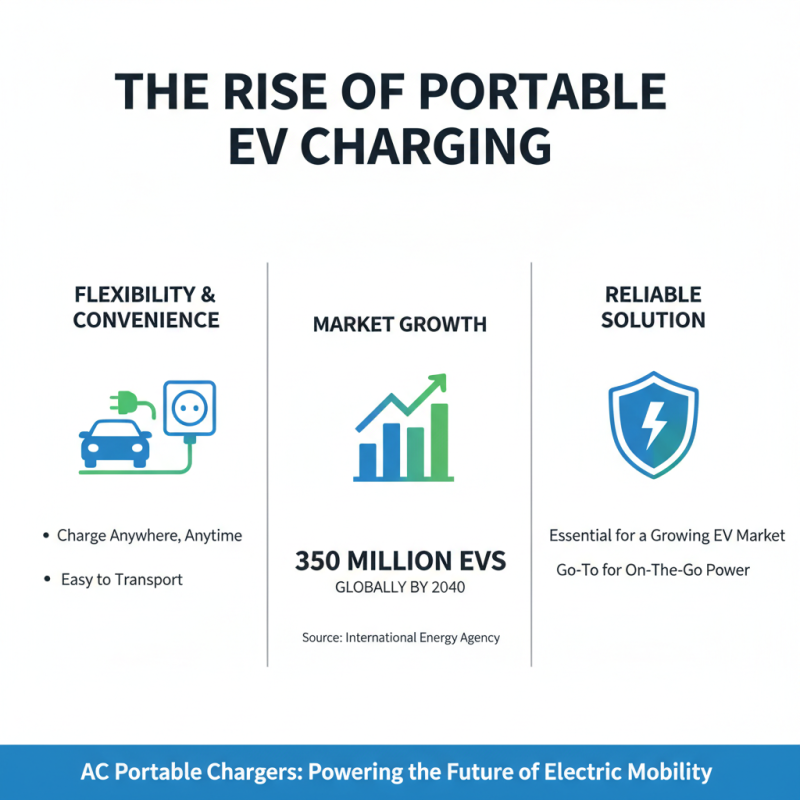
Electric vehicle (EV) owners are increasingly turning to AC portable chargers. These chargers offer significant flexibility and convenience. According to a report from the International Energy Agency, the global EV market is expected to reach 350 million units by 2040. This growth emphasizes the need for reliable charging solutions.
AC portable chargers are lightweight and easy to carry. They can be plugged into standard outlets, ensuring that charging locations are accessible. Recent industry studies show that 70% of EV owners prefer using portable chargers for their home charging needs. However, the charging speed might not match that of fixed solutions, which can be a drawback.
Another crucial benefit is the adaptability of AC portable chargers. They can be used on road trips or while visiting friends and family. This versatility becomes essential as more people embrace electric vehicles. Yet, potential range anxiety still exists due to limited charging infrastructure in some areas. Users must plan their trips carefully, considering charging times and locations. Nevertheless, the convenience of an AC portable charger can significantly enhance the EV ownership experience.