
Wall Mounting EV Charge Station
China Top 10 AC V2L Cable Manufacturers for Global Buyers
Global buyers are paying closer attention to vehicle-to-load technology, especially as electric vehicles support emergency power, outdoor work, and mobile energy use. This guide examines China’s top 10 Ac V2l Cable manufacturers and the practical details behind their market reputations. It considers connector design, conductor quality, insulation strength, temperature control, and production consistency. These factors matter when a cable must power a refrigerator beside a campsite or tools on a construction site.
“An Ac V2l Cable should be judged by measured performance, not attractive packaging,” says Dr. Li Wei, an independent EV charging systems engineer. “Buyers need traceable testing, stable materials, and clear compatibility information.” His observation reflects a common sourcing challenge. A cable may appear robust, yet its contact resistance, sealing performance, or strain relief may remain uncertain. Small details can create large operational problems.
The manufacturers discussed here are evaluated through a buyer-focused lens. Their product ranges, quality systems, customization capabilities, export experience, and technical documentation receive attention. Relevant checks may include voltage ratings, current capacity, connector fit, thermal behavior, and inspection records. Buyers should also confirm vehicle compatibility before placing larger orders. Not every catalog is complete. That is worth remembering.
Some suppliers communicate well but offer limited engineering evidence. Others provide strong testing but weaker after-sales support. This guide does not treat factory size as a guarantee of reliability. Instead, it encourages careful comparison, sample testing, and direct technical questions. Real-world performance deserves more weight than promotional language.
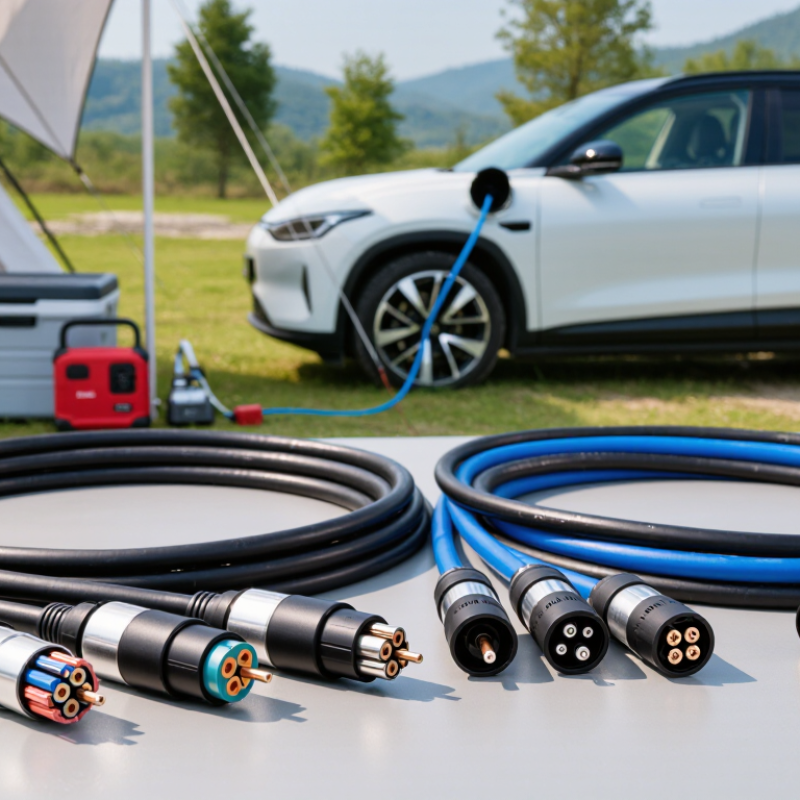
AC V2L Cable Fundamentals: Type 2, J1772, and 3.6–7.2 kW Classes
AC V2L cables connect an electric vehicle to household appliances during travel, field work, or emergency power use. They are not ordinary charging cables. A vehicle-side inverter must provide the power, while the cable safely transfers it to an external socket.
Type 2 connectors are common across many European charging systems. J1772 connectors remain widely used in North American vehicles. Their physical designs differ, so compatibility must be checked before ordering. A Type 2 cable may support single-phase output, but the vehicle’s V2L adapter determines the real function. Cable selection alone cannot create bidirectional power.
The 3.6 kW class usually works near 16 amps at 230 volts. The 7.2 kW class may reach 32 amps under suitable conditions. Actual output can be lower. Appliance startup loads, cable temperature, grounding, and vehicle software all matter. In practical testing, a heater may run steadily while a compressor causes temporary overload protection. That detail is easy to miss.
Global buyers should request conductor size, insulation rating, connector temperature limits, ingress protection, and test documentation. They should also verify residual-current protection and regional plug requirements. A longer cable feels convenient, but it can increase voltage drop and handling risks. Some specifications look impressive on paper. Field performance deserves more attention.
How AC V2L Cables Operate: Inverters, Pilot Signals, and Safety Limits
An AC V2L cable connects an electric vehicle’s traction battery system to external appliances. Inside the vehicle, an inverter changes battery DC into household-style AC. The cable does not create unlimited power. It only transfers the output approved by the vehicle and its control system.
Pilot signals help confirm connection, readiness, and permitted current. Depending on the design, CP and PP communication can prevent output before the plug is fully seated. The vehicle may also monitor insulation, temperature, grounding, and leakage. These details matter more than cable appearance. A cable rated for high current may still be unsuitable if the vehicle limits discharge to a lower level. Real installations can be less tidy than diagrams suggest.
Tips: Check the vehicle’s V2L power rating, socket type, voltage, frequency, and continuous-current limit before sourcing. Ask manufacturers for insulation-test results, conductor size, connector temperature data, and protection details. Confirm that the cable supports the intended appliance load, especially motors and compressors with high starting current. Keep connectors dry and avoid coiling a loaded cable tightly. One overlooked issue is heat buildup. Test under realistic conditions, not only for five minutes. Supplier claims should be compared with traceable test records and clear operating instructions.
China’s Top 10 AC V2L Cable Manufacturers: Products and Capabilities
China’s leading AC V2L cable manufacturers serve different vehicle and market requirements. Some produce Type 2-to-domestic socket cables for European applications. Others develop GB/T-compatible assemblies for Chinese vehicles. Several factories also support custom plugs, cable lengths, and current ratings.
Their capabilities vary in important details. Established producers typically use copper conductors, heat-resistant insulation, molded connectors, and reinforced strain relief. Many offer 10A, 16A, or 32A configurations, depending on the vehicle output. Weather-resistant housings help outdoor users. However, IP ratings should be checked against test reports, not product images. A well-made cable should maintain stable contact during continuous loads and repeated bending.
Quality control often includes insulation resistance testing, grounding checks, temperature-rise measurement, and plug insertion testing. Some suppliers provide sample approval, laser marking, packaging customization, and small-batch production. This helps importers validate compatibility before placing larger orders. Factory visits can reveal practical details, such as cable storage conditions and connector assembly methods. Small weaknesses matter. A stiff cable may become difficult to coil in winter. A loose cap may reduce water protection over time. Buyers should compare technical drawings, certificates, warranty terms, and real test samples before selecting among China’s top ten AC V2L cable manufacturers.
China's Top 10 AC V2L Cable Manufacturers: Products and Capabilities
Common AC V2L rated output scenarios for global buyer reference
The chart compares common nominal AC voltage and current combinations used in regional power systems. Theoretical output is calculated as voltage × current, assuming a power factor of 1. Actual vehicle-to-load limits, cable ratings, connector types, and protection requirements vary by vehicle, market, and applicable standards such as IEC 61851 and IEC 62196.
Supplier Evaluation: IEC 62196, CE, RoHS, IP Ratings, and Testing
When evaluating China’s top AC V2L cable manufacturers, global buyers should inspect evidence, not polished catalog claims. IEC 62196 compatibility matters because plug geometry, contact design, and rated current must match the vehicle and outlet. Ask for the exact standard part, edition, and test scope. A certificate without model numbers is weak evidence. Check it carefully.
CE marking is not a universal quality award. Request the EU Declaration of Conformity, risk assessment, and laboratory reports linked to the finished cable assembly. RoHS documentation should identify restricted substances and supplier controls, preferably with material declarations and recent screening records. Traceability matters in practice. Each cable should carry a batch code, conductor specification, and production date. Small details reveal process maturity.
IP ratings deserve practical verification. An IP55 claim may not describe the connector when uncoupled, bent, or exposed to spray. Ask whether testing followed the claimed enclosure standard, with photographs, samples, and recorded conditions. Reliable factories should show continuity, insulation resistance, dielectric strength, temperature-rise, and flexing tests. I would request independent retesting before volume orders. It adds cost. Yet a missing report can cost more. Factory answers are sometimes incomplete, and that is a useful warning, not a reason to guess.
Global Buyer Checklist: MOQ, Lead Time, Customization, and Warranty
When comparing China’s leading AC V2L cable manufacturers, global buyers should verify MOQ before discussing price. A low unit cost may hide a high minimum order. For a trial shipment, 50 to 200 pieces is often more practical than a full container. Ask for production samples, test records, connector specifications, and traceability documents. A reliable supplier should explain cable temperature limits, current ratings, and insulation performance clearly.
Lead time deserves equal attention. Standard cables may ship within 15 to 25 working days, while customized designs can require 35 to 50 days. Confirm whether testing, packaging, and export inspection are included. Customization may cover cable length, plug type, labeling, color, and packaging. However, every change can affect tooling or approval time. I have found that vague drawings create costly revisions. That mistake is easy to underestimate. Warranty terms should define coverage, exclusions, response time, and replacement procedures. A 12- to 24-month warranty is useful only when technical support remains available after delivery.
Tips: Request one sample before placing a large order. Compare actual cable flexibility, connector fit, and strain relief. Ask for a written lead-time schedule. Keep communication records. If a supplier avoids clear answers, pause the purchase. Also, review warranty claims from similar products, not only promotional promises.
China Top 10 AC V2L Cable Manufacturers for Global Buyers - Global Buyer Checklist: MOQ, Lead Time, Customization, and Warranty
| Supplier Profile | Typical AC V2L Output | Cable Length Options | MOQ | Sample Lead Time | Mass-Production Lead Time | Customization Capability | Common Protection Features | Typical Warranty | Key Buyer Verification Point |
|---|---|---|---|---|---|---|---|---|---|
| Profile 01 | 230 V, 10–16 A; up to 3.6 kW | 3 m, 5 m, 7 m | 100 pcs | 7–10 working days | 20–25 working days | Cable length, plug type, color, labeling, packaging | IP54 housing, over-temperature protection, strain relief | 12 months | Confirm socket standard and vehicle-side connector compatibility |
| Profile 02 | 230 V, 16 A; up to 3.6 kW | 5 m, 8 m, 10 m | 200 pcs | 8–12 working days | 25–30 working days | Molded plug, cable marking, carton design, private label | IP55, short-circuit protection, flame-retardant materials | 12–18 months | Request temperature-rise data at the rated continuous current |
| Profile 03 | 230 V, 16 A; up to 3.6 kW | 3 m, 5 m, 7.5 m | 300 pcs | 10–14 working days | 25–35 working days | Regional plug, cable jacket, connector housing, instruction manual | IP54, grounding continuity, over-current protection | 18 months | Check protective-earth continuity and polarity test records |
| Profile 04 | 230 V, 16 A; up to 3.6 kW | 5 m, 10 m, 15 m | 500 pcs | 10–15 working days | 30–40 working days | Cable gauge, jacket color, plug configuration, packaging | IP55, thermal cutoff, reinforced cable gland | 24 months | Verify voltage drop and connector heating over the full cable length |
| Profile 05 | 110–120 V, 12–15 A; up to 1.8 kW | 3 m, 5 m, 7 m | 100 pcs | 7–12 working days | 20–30 working days | North American plug, fuse option, cable color, retail box | Overload protection, grounding check, heat-resistant plug | 12 months | Confirm local plug, fuse, certification, and continuous-load rating |
| Profile 06 | 230 V, 10–16 A; up to 3.6 kW | 3 m, 5 m, 10 m | 200 pcs | 8–14 working days | 25–35 working days | Connector type, strain-relief design, labeling, manuals | IP54, insulation monitoring, over-temperature protection | 18–24 months | Ask whether the cable is designed for the vehicle’s approved V2L outlet |
| Profile 07 | 230 V, 16 A; up to 3.6 kW | 5 m, 7 m, 10 m | 300 pcs | 10–15 working days | 30–40 working days | Custom plug, connector shell, cable jacket, barcode label | IP55, flame-retardant housing, short-circuit protection | 24 months | Review material certificates and flammability test documentation |
| Profile 08 | 230 V, 16 A; up to 3.6 kW | 3 m, 5 m, 8 m | 500 pcs | 12–18 working days | 35–45 working days | Full OEM packaging, cable specification, connector molding | IP54, leakage-current protection, thermal sensing | 24 months | Clarify whether leakage protection is integrated or vehicle-dependent |
| Profile 09 | 230 V, 10–16 A; up to 3.6 kW | 5 m, 10 m, 15 m | 100 pcs | 7–10 working days | 20–30 working days | Length, plug adapter, cable color, instruction sheet | IP54, over-current protection, abrasion-resistant jacket | 12–18 months | Confirm bend radius, jacket flexibility, and outdoor-use limitations |
| Profile 10 | 230 V, 16 A; up to 3.6 kW | 3 m, 5 m, 7 m, 10 m | 200 pcs | 8–12 working days | 25–35 working days | Vehicle-side connector, regional outlet, packaging, documentation | IP55, grounding verification, over-temperature protection | 18–24 months | Obtain a written compatibility list for the target vehicle models |
Related Posts
-
Best Ac V2l Cable What to Know Before You Buy?
-
Top 10 Electric Car Recharge Stations You Need to Know?
-
China Best AC Portable EV Charger Options for Eco-Friendly Drivers?
-
Top 10 China EV Charging Stations Buyers Should Know?
-
Innovative Trends in Home Ev Charger Technology at the 138th China Import and Export Fair 2025
-
Top 10 Ac Ev Chargers in China for Global Buyers?