2026 How to Choose an AC V2L Cable for Global Buyers?
Choosing an Ac V2l Cable in 2026 requires more than comparing prices or connector pictures. Global buyers must match the cable with the vehicle’s V2L outlet, regional socket, voltage, current rating, and intended appliance load. A cable that works safely with a small lamp may not suit a workshop tool or outdoor refrigerator. Check the vehicle manual before trusting a supplier’s product description.
Real-world conditions also matter. A cable used beside a campsite may face rain, dust, heat, repeated coiling, and muddy hands. Look for clear specifications, strong strain relief, appropriate insulation, reliable contacts, and practical ingress protection. Verify whether the cable supports the required continuous current, not only a short peak rating. Independent test reports and traceable manufacturer information provide stronger evidence than vague claims such as “universal” or “heavy duty.”
A perfect choice does not exist. Some buyers may overvalue flexibility and overlook heat management. Others may select a low-cost cable without checking local plug compatibility. That mistake can create nuisance trips, poor appliance performance, or unsafe overheating. This guide explains how to compare Ac V2l Cable options through safety documentation, material quality, regional compatibility, warranty support, and field usability. It also considers differences among Europe, North America, Asia-Pacific, and other markets, where outlets and electrical requirements vary. Always confirm local installation and usage requirements with a qualified professional. Supplier advice helps, but it should not replace vehicle documentation, testing evidence, or careful inspection before every use.
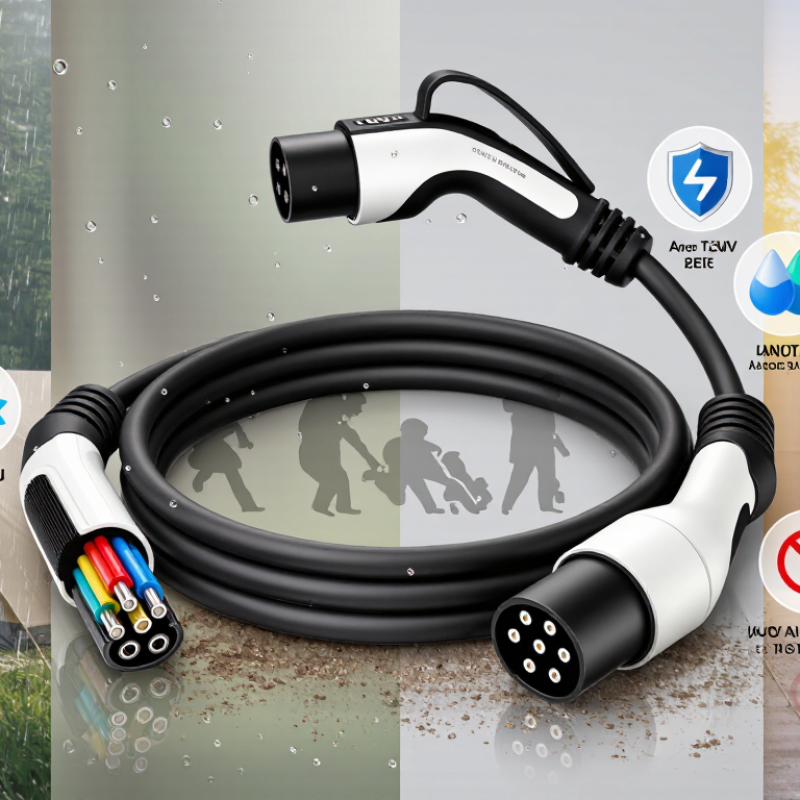
AC V2L Cable Basics: 230–240 V, 16–32 A, and 3.7–7.4 kW Ratings
AC V2L Cable Basics: 230–240 V, 16–32 A, and 3.7–7.4 kW Ratings
An AC V2L cable transfers power from an electric vehicle to compatible appliances or temporary equipment. Its key figures are voltage, current, and maximum output. At 230 V and 16 A, the theoretical output is about 3.7 kW. At 230 V and 32 A, it reaches approximately 7.4 kW. At 240 V, the calculated values rise slightly to 3.8 kW and 7.7 kW.
That difference matters.
Real loads may require less power than the label suggests. Continuous heating equipment can create high thermal demand, while motors may draw extra current during startup. A cable rated at 32 A does not automatically make the vehicle deliver 32 A. The vehicle, V2L adapter, connector, and protection system must support the same level. I check every limit before connecting a load.
Cable size and insulation quality also deserve attention. For longer runs, voltage drop and heat become more noticeable.
Look for clear markings, secure strain relief, proper earthing, and protection against moisture when outdoor use is expected.
IP protection helps, but it does not make every connection weatherproof. That assumption is easy to make.
A practical choice is often a 16 A cable for lights, chargers, and small tools. A 32 A cable suits higher loads only when the vehicle and installation permit it. Local socket standards also differ, so connector fit is not enough. I would verify the vehicle manual and electrical requirements rather than trust a simple kW claim.
Connector Selection Under IEC 62196-2: Type 2, Type 1, and Regional Fit
2026 How to Choose an AC V2L Cable for Global Buyers?
Connector choice begins with the vehicle inlet, not the wall socket. Under IEC 62196-2, Type 2 is widely used across Europe and several other markets. It commonly supports single-phase or three-phase AC charging. Type 1 remains common in North America and Japan, usually for single-phase systems. The plug may look familiar, but regional wiring can differ.
Check the vehicle’s V2L function before ordering. A Type 2 inlet does not automatically provide AC output. The vehicle must support bidirectional discharge, and its software may limit current or operating time. Confirm the cable’s rated voltage, current, conductor size, temperature range, and protection level. A warm connector after ten minutes is a warning, not a minor detail.
Outlet selection needs equal attention. A household socket may accept the plug but still lack suitable grounding or continuous-load capacity. In field checks, cable length often creates another problem: buyers choose a long cable, then face heavier handling and greater voltage drop. Shorter is not always better. Regional socket standards, outdoor exposure, and emergency disconnection needs should guide the final choice. A careful buyer should verify every interface with the vehicle manual and local electrical requirements.
Cable Sizing for V2L Loads: 2.5–6 mm² Conductors and Voltage Drop
2026 How to Choose an AC V2L Cable for Global Buyers?
AC V2L cable sizing starts with load current, cable length, and installation conditions. A 2.5 mm² copper conductor can suit moderate loads over short distances, such as lighting or a small refrigerator. At 230 V, a 10 A load uses about 2.3 kW. Higher continuous loads may require 4 mm² or 6 mm² conductors, especially when the cable runs outdoors or exceeds 20 metres. The vehicle outlet, plug, and socket ratings still limit the usable current.
Voltage drop matters more than many buyers expect. A long, undersized cable can make a heater perform poorly and increase connector heating. For a 16 A load, a 4 mm² cable usually offers better stability than 2.5 mm² on longer routes. A 6 mm² cable may be sensible for demanding loads, but it adds weight and costs more. Bigger is not automatically better. I have seen careful calculations fail because coiled cables trapped heat.
Tips: Measure the complete cable route, not just the straight distance. Check the rated current of every connector. Fully unwind the cable during sustained operation. Use a suitable residual-current protection system where required. Confirm local electrical rules before use, because voltage, plug standards, and installation methods vary globally. When conditions are uncertain, choose a qualified electrician’s inspection over guesswork.
2026 How to Choose an AC V2L Cable for Global Buyers? - Cable Sizing for V2L Loads: 2.5–6 mm² Conductors and Voltage Drop
AC V2L cable sizing guide based on a 230 V single-phase supply
| Conductor Cross-Section |
Typical Copper Cable Type |
Illustrative Continuous Design Current |
Approx. Load at 230 V |
Voltage Drop at 10 m One-Way* |
Approx. Drop Percentage |
Suitable V2L Load Examples |
Selection Guidance |
| 2.5 mm² |
Flexible copper, 3-core |
16 A |
3.68 kW |
2.24 V |
0.97% |
Lighting, laptops, refrigerators, small pumps, chargers and general household appliances |
A practical choice for standard 10–16 A V2L outlets when the cable run is moderate and installation conditions are suitable. |
| 4 mm² |
Flexible copper, 3-core |
20 A |
4.60 kW |
1.75 V |
0.76% |
Multiple household appliances, portable induction cookers, medium pumps and higher-duty resistive loads |
Recommended where the cable is longer, bundled, exposed to warmer conditions or expected to carry near-continuous loads. |
| 6 mm² |
Flexible copper, 3-core |
25 A |
5.75 kW |
1.46 V |
0.63% |
Higher-power tools, compressors, heaters and demanding loads requiring improved thermal margin |
Useful for long cable runs or high-duty applications, but the vehicle outlet, plug, protective device and connector must support the current. |
Technical notes:
The voltage-drop figures use a copper resistivity of approximately 0.0175 Ω·mm²/m, a 230 V single-phase circuit, a 10 m one-way cable length, and a two-conductor current loop. Actual cable ampacity depends on insulation temperature rating, ambient temperature, installation method, grouping, connector ratings and local electrical regulations. The vehicle’s V2L output limit always takes priority over the cable’s theoretical capacity.
Global selection reminder:
At 120 V, the same current delivers approximately half the power available at 230 V, and the same voltage drop represents a higher percentage of the supply voltage. Confirm the local voltage, plug standard, grounding arrangement, protection requirements and maximum V2L current before selecting the cable.
Global Buying Checklist: 1–10 m Lengths, Certifications, Testing, and Warranty
Choosing an AC V2L cable starts with the vehicle, not the product photo. The IEA’s Global EV Outlook 2025 reported more than 17 million electric cars sold in 2024. That growth increases demand for dependable power-transfer accessories. Select a 1–10 m length after measuring the parking space, outlet position, and equipment distance. Short cables reduce voltage drop and trip hazards. Longer cables improve reach but need stronger strain relief. Check rated voltage, continuous current, connector type, and temperature limits. A cable should match the vehicle’s V2L output, not only the household socket.
Tips: Request test evidence, not vague compliance claims. Look for IEC 62196 connector testing, IEC 61851 charging-system compatibility, and IEC 62752 protection-device requirements where applicable. Ask whether laboratories are accredited under ISO/IEC 17025. Test records should cover insulation resistance, earth continuity, thermal rise, water resistance, and residual-current protection. Certifications vary by destination, so verify local plug and socket rules before purchase.
Warranty terms deserve equal attention. A practical global checklist should state coverage length, replacement procedure, excluded damage, and support response time. Two or three years may be reasonable, but the wording matters more than the number. The IEA also notes that charging infrastructure must expand rapidly with EV adoption, yet accessory quality is not always equally visible. A polished housing proves little. I would request batch traceability, user instructions, and photos of internal protection. One overlooked detail can matter. Consider independent retesting after repeated bending, outdoor storage, and high-load operation, because laboratory-new conditions rarely represent daily use.
2026 How to Choose an AC V2L Cable for Global Buyers?
Global Buying Checklist: 1–10 m Lengths, Certifications, Testing, and Warranty
How to read the chart
The chart shows the estimated round-trip voltage drop for a 230 V AC, 16 A load using a 2.5 mm² copper conductor.
The calculation uses copper resistivity of approximately 0.0175 Ω·mm²/m and a two-way cable length:
voltage drop = 16 A × (0.0175 × 2 × cable length ÷ 2.5). Actual results depend on conductor size,
ambient temperature, connector resistance, installation conditions, and the vehicle or power station.
Length selection
Confirm the shortest practical length from 1–10 m to reduce voltage drop, weight, and storage space.
Certification review
Request applicable conformity evidence for the destination market, such as IEC 61851 and IEC 62196-2 references for compatible EV charging interfaces.
Testing checklist
Verify continuity, insulation resistance, protective-earth continuity, dielectric strength, temperature rise, mechanical flexing, and ingress protection where applicable.
Warranty requirements
Ask for a written warranty period, covered defects, test records, batch traceability, rated current, operating temperature, and replacement procedure.