
Wall Mounting EV Charge Station
Which AC EV Charging Cable Type Is Best in 2026?
Choosing the best Ac Ev Charging Cable in 2026 starts with a practical question: what connector does your vehicle accept? A Type 2 plug suits many vehicles in Europe, while Type 1 remains common in some other markets. Neither is universally best. The right choice depends on your car’s inlet, the charging equipment, and local electrical supply.
Demand makes that choice increasingly relevant. The International Energy Agency’s Global EV Outlook 2025 reports that electric car sales exceeded 17 million in 2024, accounting for more than one in five new cars sold worldwide. The agency also projected sales above 20 million in 2025. Those figures describe vehicle sales, not cable performance. Still, they show why compatibility and safe charging matter to more drivers.
A useful comparison looks beyond the plug shape. Check the cable’s rated current, supported charging power, phase compatibility, length, and weather protection. A 5-metre cable may reach neatly across a driveway; a longer one can help in a tight parking space but add weight and storage hassle. Small details matter. Follow the vehicle and charger manufacturers’ specifications, and verify that the cable meets applicable regional standards, such as IEC 62196 where relevant. A higher rating does not make charging faster if the vehicle or charging point cannot use it. That is easy to overlook. This guide compares common AC cable types and explains how to match one to real-world needs—without pretending one connector fits every driver.
How AC EV Charging Cables Deliver Power
Which AC EV Charging Cable Type Is Best in 2026?
How AC EV Charging Cables Deliver Power
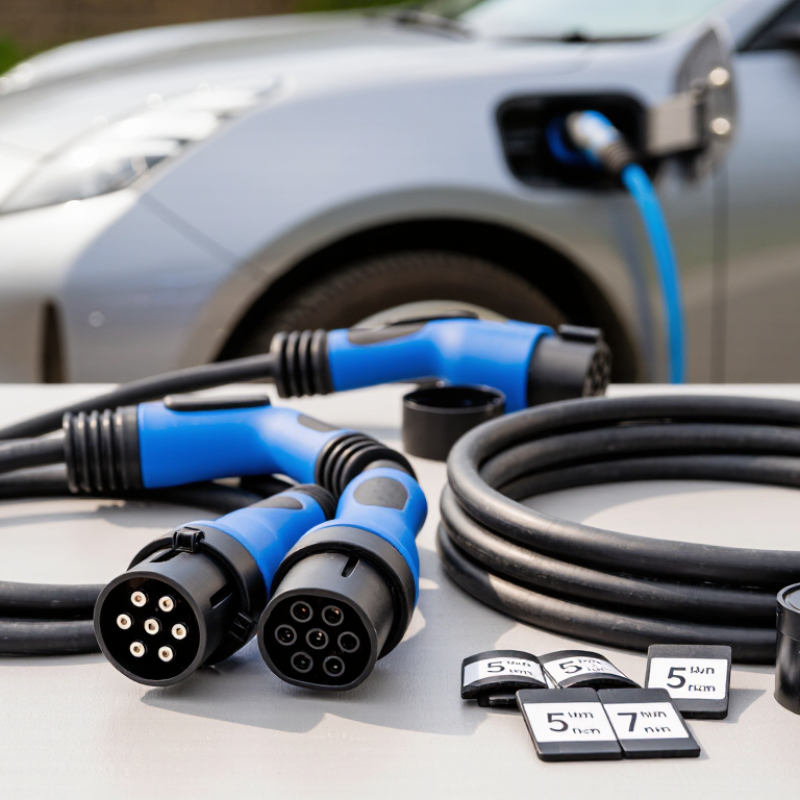
An AC charging cable links a charging point to your vehicle, carrying alternating current through matching connectors. The car’s onboard charger then converts that AC power into direct current for the battery. The cable itself does not set the vehicle’s charging speed. The charging point, onboard charger, electrical supply, and cable rating all play a part. Small details matter.
Many home setups use single-phase AC, while some sites provide three-phase power. A three-phase connection can deliver more power when the vehicle supports it. Check the vehicle manual and charging equipment specifications before choosing a cable. Look at connector compatibility, current rating, and length. A cable that reaches the parking spot comfortably is useful; an overly long one can be awkward to coil and store. A higher rating alone does not guarantee faster charging. That point is easy to overlook.
Tips: Check both ends of the cable, not just the vehicle socket. Keep connectors clean and dry, and inspect the cable for cuts or crushed sections. If charging feels slower than expected, compare the car’s AC limit with the charging point’s output. I would not assume the cable is the problem without checking those limits first. Sometimes the answer is less obvious.
Which AC EV Charging Cable Type Is Best in 2026?
How AC EV charging cables deliver power: the connector and electrical supply determine the available AC power, while the vehicle’s onboard charger sets how much it can accept.
Illustrative rated power is calculated from voltage, current, and phase: single-phase 230 V at 32 A is about 7.4 kW; three-phase 400 V at 32 A is about 22.2 kW; and three-phase 400 V at 63 A is about 43.6 kW. Type 1 is typically single-phase, while Type 2 supports single- and three-phase AC. Actual charging power may be lower depending on the vehicle, charging station, cable rating, and electrical supply.
AC Charging Cable Types and Connector Standards
AC charging cable choice depends on the connector standards used by both the vehicle and the charging point. Type 1, also known as SAE J1772, is common in North America and typically supports single-phase AC charging. Type 2, defined by IEC 62196-2, is widely used in Europe and can support single- or three-phase charging when the vehicle and supply allow it. The plug alone does not determine charging speed.
Fit matters. A tethered cable stays attached to the charging unit, making public charging quicker to start. A detachable cable is easier to store and can serve at compatible public points, but it means carrying the cable in the car. Check the connector at both ends, the cable’s current rating, and whether it supports the vehicle’s AC limit. A three-phase cable will not make a single-phase vehicle charge faster. Not always.
In China, GB/T AC connectors are used under a different standard, so a cable designed for another region may not fit. Adapters are not a safe guess; confirm that the vehicle, cable, and charging equipment are explicitly compatible. Look for intact insulation and firm, undamaged pins, especially after a cable has spent months in a damp trunk. I still find connector names confusing across regions, and labels can be easy to misread. That small detail deserves a careful check before purchase.
Which AC EV Charging Cable Type Is Best in 2026? - AC Charging Cable Types and Connector Standards
| AC connector type | Common use | Typical AC capability | Relevant standard | Practical selection note |
|---|---|---|---|---|
| Type 1 (SAE J1772) | Common on AC-charging vehicles and equipment in North America; also found on some older vehicles in other markets. | Single-phase; commonly up to 32 A at 240 V, or about 7.7 kW, when supported by the vehicle and supply. | SAE J1772; connector requirements are also covered by IEC 62196-2. | Choose a Type 1 cable when the vehicle inlet is Type 1. The vehicle’s onboard charger may limit the actual charging rate. |
| Type 2 (Mennekes) | Widely used for AC charging in Europe and many other markets. | Supports single- or three-phase AC. A common three-phase setup is 32 A at 400 V, providing up to about 22 kW. | IEC 62196-2. | A 32 A cable is a common choice for 22 kW-capable equipment, but the vehicle, EVSE, installation, and cable must all support the chosen current and phase configuration. |
| SAE J3400 | Used by compatible vehicles and charging equipment, primarily in North America. | AC capability depends on the vehicle and EVSE. Supported systems can reach 80 A at 240 V, or 19.2 kW. | SAE J3400. | Check that both the vehicle inlet and charging equipment support J3400. Do not assume every J3400 installation supplies the connector’s highest possible AC current. |
| GB/T AC connector | Used for AC charging on vehicles and equipment designed for the relevant Chinese-market interface. | Common single-phase configurations include up to 32 A at 250 V, approximately 8 kW nominally; actual charging power depends on the system. | GB/T 20234.2. | Match the cable to the vehicle inlet and the local EVSE. Connector appearance alone does not establish electrical or control compatibility. |
Charging modes: how the AC connection is controlled
| IEC 61851 mode | How it works | Typical context | Key consideration |
|---|---|---|---|
| Mode 1 | Connection to a standard AC socket without in-cable EV control and protection functions. | Limited or unsuitable for many modern EV-charging situations. | Its use is restricted or prohibited in some jurisdictions. Follow local rules and use an approved charging setup. |
| Mode 2 | Uses a standard AC socket and a cable incorporating an in-cable control and protection device (IC-CPD). | Portable charging from a suitable socket. | Confirm the socket, circuit, and IC-CPD are suitable for the current and local electrical requirements. |
| Mode 3 | AC charging through dedicated EV supply equipment (EVSE), with control and safety functions provided by the charging system. | Common for home and public AC charging. | Usually the practical choice for regular AC charging. Match the cable connector, current rating, and phase capability to the EVSE and vehicle. |
Best choice in 2026: There is no single best AC cable type for every EV. Choose the connector that matches the vehicle inlet, then select a cable with a current and phase rating supported by both the vehicle and the EVSE. Charging power is limited by the lowest-rated component in the complete charging setup.
Key Factors That Affect Cable Compatibility and Performance
Which AC EV Charging Cable Type Is Best in 2026?
Cable compatibility starts with the connectors at both ends. Match the vehicle inlet and charging-point socket, then check the cable’s rated current and voltage. A plug that fits is not enough. The vehicle’s onboard charger and the charging unit also limit power. For example, 230 volts at 32 amps is about 7.4 kW; a three-phase setup may support more, if both devices allow it. IEC 62196 defines connector requirements, while IEC 61851 covers conductive charging equipment.
Cable rating affects safe, reliable performance. A cable rated below the charging unit’s output can restrict charging, and poor handling or heat can add stress. Choose a practical length: extra cable can be awkward to coil, while a short lead may not reach a driveway socket. Heat matters. Check the manufacturer’s current rating and temperature limits, and inspect for cracked insulation or bent pins.
IEA’s Global EV Outlook 2024 reports that public charging points grew by 40% in 2023, reaching more than four million. As charging options expand, connector compatibility matters even more. Still, a higher-rated cable does not make a car charge faster if its onboard charger sets a lower limit. I have seen cable length treated as an afterthought; it is easy to regret when the parking space changes.
Comparing AC EV Charging Cable Types in 2026
Comparing AC EV Charging Cable Types in 2026 starts with the connector your vehicle accepts. Type 1 is generally a single-phase option, while Type 2 supports single- and three-phase AC charging. In practical terms, three-phase charging can deliver more power when the vehicle, cable, and charging point all support it. The IEC 62196-2 standard defines these connector configurations. Fit matters most.
Regional compatibility matters, too. Type 2 is common across Europe, while other markets use different standards, including Type 1 or GB/T. A cable’s current rating, phase capability, length, and temperature rating affect suitability. For example, a 5-metre cable may reach comfortably in a driveway but fall short when a charging post sits behind the parking space. Check the label. The confusing part is that connector shape alone never tells the whole story; the car’s onboard charger may limit AC power.
For occasional charging from a household outlet, a Mode 2 cable includes in-cable control and protection. For regular charging at a dedicated AC point, Mode 3 is typically the more practical choice. The International Energy Agency reported more than 17 million electric car sales in 2024, exceeding 20% of global car sales (Global EV Outlook 2025). That growth makes compatibility worth checking before purchase, not guessing afterward. Compare the vehicle manual with the cable specifications, and avoid choosing by maximum kilowatts alone. A higher rating is not automatically a better match.
Choosing a Cable for Your Vehicle and Charging Setup
The best AC charging cable is the one that fits both your vehicle and your charging equipment. Check the inlet on your car and the connector on your wall unit or portable charger. Type 1 and Type 2 are common standards, but availability varies by region. Read the vehicle manual rather than guessing from the model year. Fit matters most.
Match the cable’s rated current and phase capability to your charging setup. The car, charging unit, and cable all affect the power you can actually use. A higher-rated cable will not make a lower-powered charger faster. Choose enough length to reach the inlet without stretching, but avoid excess cable trailing across a walkway. I used to think extra length was always useful; in a small garage, it can become a trip hazard. For outdoor use, check that the cable is rated for the conditions and inspect it for cuts or damaged pins.
Tips: Compare both connector ends before buying. Check the rating label. Measure the route from charger to car, including where the cable must bend. Store it loosely, and stop using it if the plug feels unusually hot or the casing is damaged.
Related Posts
-
How to Find Top EV Charging Cable Suppliers in China?
-
How to Choose the Right EV Charging Cable?
-
Top EV Charging Cable Suppliers for Global Buyers?
-
How to Choose the Right AC EV Charging Cable?
-
What is the Best Ac Ev Charging Cable for Electric Vehicles?
-
10 Best Electric Car Recharge Stations for Global Buyers